With the
Azure AD Conditional
Access feature, rules for access to Microsoft Cloud Services and other apps
registered in Azure AD can be bound to conditions.
An example
is the rule: When accessing with an unmanaged device, the user is prompted
to use multi-factor authentication.
With the
feature "Use Conditional Access App Control" as an option in the
Session Controls area within Azure AD Conditional
Access, advanced scenarios can be setup.
Options:
Prevent
data exfiltration
Protect
on download
Prevent
upload of unlabeled files
Block
potential malware
Monitor
user sessions for compliance
Block
access
Block
custom activities
Example:
Automatically
assign a sensitivity label when a file is downloaded.
Filter
based on regular expressions: “Include Files that match a custom expression”
Block
Upload if Maleware is detected.
This is can be done because the Cloud
App Security service then acts as a proxy for accessing the application:
To register
an app, the wizard can be used in Cloud App Security via Investigate ->
Connected Apps -> Conditional Access App Control Apps. Another and much
simpler way is to use a conditional access policy as an easy start:
Azure
AD Security -> Conditional Access
New
Policy
Section
„Access controls“ -> „Session“
Use
„Use Conditional Access App Control“
Use
„Use custom policy to set an advanced policy in Cloud App Security“
Configure
the policy in the menus "Users and Groups" etc. that it will be
applied the next time the app to be registered is started. This then results in
apps that are authenticated via Azure AD being automatically registered in
Cloud App Security under „Conditional Access App Control“:
The above
method works for the so called featured
apps. In order to make this option work for the Office
365 Featured Apps, Office 365 must be registered under "Connected
Apps" in Cloud App Security:
Once an app
is registered, session policies can be created that will take effect when the
app is used.
Example: If the user Oliver Hardy tries to download a
document from Microsoft Teams (SharePoint) that contains the term
"confidential", the download is blocked.
Further scenarios
Monitor / block activities based on file conditions like Classification Label, File Name, Files Size or File Extension
When
opening the app, the user is notified that access is monitored by Cloud App
Security. The fact that a proxy is involved can also be recognized by the URL.
This now has the addition access-control.cas.ms:
If the user
Oliver Hardy now tries to download a document he gets the following message:
When to use what – Azure Sentinel,
CASB, Azure Security Center, Security & Compliance Center in Office 365,
etc.
Many
customers using Microsoft Cloud Services in the context of collaboration und
communication often asked the “When to use what” question. Meanwhile we had
several really good methods and tools to answer this question like the Periodic Table of Office 365. At the end it is not about when to use what,
it is about “what do you want to do” or “what is your business case”? And this
is the same with the Microsoft Security Features & Services.
Microsoft
Cloud App Security is a multimode Cloud Access Security Broker (CASB). It
provides rich visibility, control over data travel, and sophisticated analytics
to identify and combat cyberthreats across all your cloud services. Further
infos about CASB
Office
365 Security & Compliance Center is designed to manage security & compliance
features across Office 365. Links to existing SharePoint and Exchange
compliance features bring together compliance capabilities across Office 365.
Microsoft
Intune is a management solution that provides mobile device, endpoint and operating
system management. It aims to provide Unified Endpoint Management for corporate
devices and BYOD.
Azure
Active Directory (Azure AD) is Microsoft’s cloud-based identity and access
management service. It covers resources, such as Microsoft Office 365, the
Azure portal, and thousands of other SaaS applications along with any cloud
apps developed by your own organization.
Microsoft
Information Protection helps an organization to classify and protect its
documents and emails by applying labels. It helps you discover, classify, label
and protect your sensitive information – wherever it lives or travels. Further
infos about Information
Protection
Protect
your enterprise from threats in the cloud and on-premises with Azure Advanced
Threat Protection. ATP is a cloud-based security solution that leverages your
on-premises Active Directory signals to identify, detect, and investigate
advanced threats, compromised identities, and malicious insider actions
directed at your organization.
Microsoft
Defender Advanced Threat Protection (ATP) is a unified platform for
preventative protection, post-breach detection, automated investigation, and
response. Microsoft Defender ATP is built into Windows 10.
Typic discussions with
customers
Azure Sentinel vs. Azure
Security Center
Azure Security Center is focusing on Azure
workloads. Azure Sentinel is used to for real-time event and detecting attacks
covering your hole architecture.
Quote
by Microsoft:To reduce confusion and simplify the user experience, two of
the early SIEM-like features in Security Center, namely investigation flow in
security alerts and custom alerts will be removed in the near future.
Individual alerts remain in Security center, and there are equivalents for both
security alerts and custom alerts in Azure Sentinel. Going forward, Microsoft
will continue to invest in both Azure Security Center and Azure Sentinel. Azure
Security Center will continue to be the unified infrastructure security
management system for cloud security posture management and cloud workload
protection. Azure Sentinel will continue to focus on SIEM. Source: Securing the hybrid cloud with Azure
Security Center and Azure Sentinel
Azure Security Center vs.
Security and Compliance Center in Office 365
The Office 365 Security & Compliance Center
is designed to help you manage security & compliance features across Office
365. Links to existing SharePoint and Exchange compliance features bring
together compliance capabilities across Office 365. Azure Security Center
analyzes data from a variety of Microsoft and also partner solutions. To take
advantage of this data, machine learning for threat
prevention, detection, and eventually investigation. Both services are part of
the Microsoft Service Trust Platform
Azure Sentinel vs. CASB
Azure Sentinel is a SIEM solution with advanced
AI and security analysis capabilities. It integrates with third-party security
platforms from vendors such as Fortinet, Symantec and Check Point, as well as
Microsoft's Graph Security API. By connecting with Microsoft Cloud App Security,
you will gain visibility into your cloud apps, get sophisticated analytics to
identify and combat cyberthreats, and control how your data travels.
Office 365 Security
Features vs. Intune
Microsoft Intune and built-in security features in
Office 365 for MDM both give you the ability to manage security &
compliance in your environment. You can manage security & compliance using
both Intune and Office 365 in the same Office 365 tenant. If you have both
options available, you can choose whether you manage security & compliance
in Office 365 or the more feature-rich Intune solution for MDM and MAM
scenarios.
Azure AD vs. Intune
Intune manages mobile devices and apps. It
integrates closely with other EMS components like Azure Active Directory for
identity and access control.
Azure Advanced Threat
Protection vs. Microsoft Defender ATP
Azure Advanced Threat Protection enables you to
integrate Azure ATP with Windows Defender ATP. While Azure ATP monitors the
traffic on your domain controllers, Windows Defender ATP monitors your
endpoints, together providing a single interface from which you can protect
your environment. By integrating Windows Defender ATP into Azure ATP, you can
leverage the full power of both services and secure your environment. Source
& Details: Integrate Azure ATP with Windows
Defender ATP
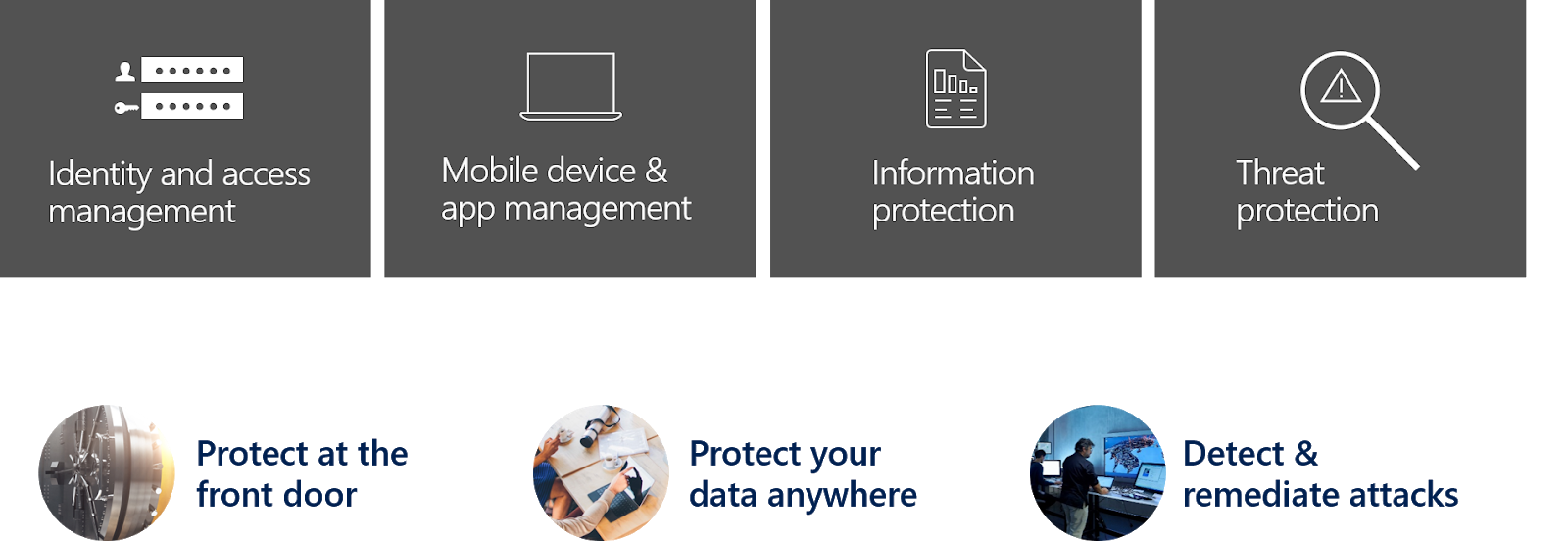
To get a solid Security & Compliance
strategy based on the Microsoft Security Stack the best way is to start with
your scenarios. Dealing with the Microsoft Security Stack a best practices
approach is to separate the topics like this:
Next step is to map the scenarios:
Protect at the front door
Protect your data anywhere
Detect & remediate attacks
to those 4 categories / topics:
Identity and access management
Mobile device & app management
Information protection
Threat protection
Periodic table &
mapping
Microsoft offers a good overview to tweak your
scenarios in this article Top 10 Actions to Secure Your
Environment.
Based on this the following overview offers a blueprint to get started with
your security strategy:
From a
planning and architecture perspective the features and services must be
separated in monitoring solution and solution used to natively setup
regulations and policies.
For example: You can use Information Protection to protect
you content and E-Mails and in addition you can integrate the Logs and Signals coming
from Information Protection to Azure Sentinel. But natively you cannot use
Azure Sentinel to protect you content and E-Mails.
This is
what end-users say about IT-Security. If you are an Admin or Data Security Officer,
you have to think about IT Security.
Microsoft
provides super useful info and material about this topic. In real world scenarios
we often had to find out where to start. And also, for this Microsoft offers a walkthrough:
I put all the stuff together
in a small Excel workbook and extend it with some further licensing info.
All
important information for your IT security strategy is summarized in this Excel.
In column 1 you will find the respective scenario, column 2 gives you an
overview and column 3 the details on the topic. Columns 4 and 5 contain further information and
details on licensing.
In the last
couple of weeks Microsoft release a bunch of new features / versions for Information
Protection and Unified Labeling:
New
features & functions with Microsoft Cloud App Security and Azure Information
Protection
Azure
Information Protection unified labeling client
Update
to Unified labeling
Cloud App Security and
Azure Information Protection
Cloud App
Security and the integration with Azure Information Protection is not new. If
you are already migrated to Office 365 unified sensitivity labels and if you
did not migrate your existing classification labels you need to know: Creating new labels in the Office 365 Security
and Compliance Center, Cloud App Security will only use the preexisting labels
configured in the Azure Information Protection portal.
Integrating
Azure Information Protection into Cloud App Security you get the ability to:
apply
classification labels as a governance action to files that match specific
policies
view
all classified files in a central location
investigate
according to classification level, and quantify exposure of sensitive data over
your cloud applications
create policies to make sure classified files
are being handled properly
This integration is focusing to scenarios like:
Visibility on
sensitive data in managed cloud apps
Compliance / Risk Enforcement
Apply label to
documents in cloud apps repositories
Prevent storage of
highly sensitive documents in the cloud
Sensitive data reporting
in AIP analytics space
Detect anomalous
access
Block download
of sensitive document from specific locations or non-compliant device
Block upload of sensitive documents
You need both a Cloud App Security license and a license for Azure
Information Protection. Then Cloud App Security syncs the labels from Azure
Information Protection. This action is performed every hour.
Scanning the files:
Automatic scan:
all new or modified files are added to the scan queue and will be scanned,
classified and protected
File policy to search
for classification labels: these files are added to the scan queue for
classification labels
After you enable Azure Information Protection on Cloud
App Security, all new files that are added to Office 365 will be scanned and you
can create new policies within Cloud App Security that apply classification
labels automatically.
Unified labeling is not activated per default and Azure
Information Protection labels can be used only by the Azure Information
Protection client. To make labels available in the Office 365 Security &
Compliance Center and to use the unified labeling client you need to Activate that
integration:
Before you
activate unified labeling, check in Office 365 that you don't have labels that
have the same name or display name as your labels in Azure Information
Protection. Note that Azure Information Protection labels will be automatically
renamed so that migration can succeed. Once activated you cannot deactivate
unified labeling for your tenant. Learn
more about the migration process.
Unified labeling: Activated
Depending on
how many labels do you have the updated takes some time. After it is done you can manage your
labels from either the Azure portal or the Office
365 Security & Compliance Center. The labels can be used by the Azure Information
Protection client and by unified labeling clients.
Note: you must use the Publish option after
the migration to make the labels available in the unified labeling clients. Otherwise
the client is showing an error like this:
In CAS we can focus policies to dedicated object. For example, you have a SharePoint Online Site with sensitive content, and you will get informed if a user is doing a mass download.
We can use the “Mass download by a single user” template to set up a policy:
In the
filter section if the policy select “edit and preview results”:
In the
shown activities list search for the location or event ion which you will
filter. In my demo I take https://sharepointtalk.sharepoint.com/teams/SearchDemo2:
Selecting “Activity
Objects” opens a report with all objects and its ID´s. To filter on the SharePoint
SiteCollection URL we need the second one: